
Dog Collar Hardware Guide: Buckles, D Rings, and More
Side Release Buckles vs. Metal Buckles
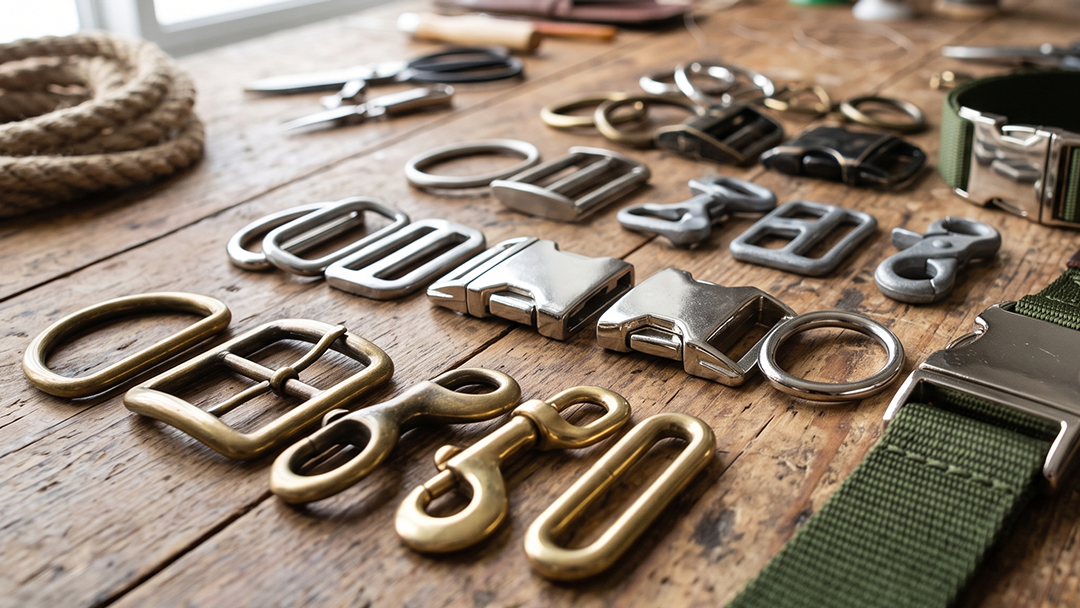
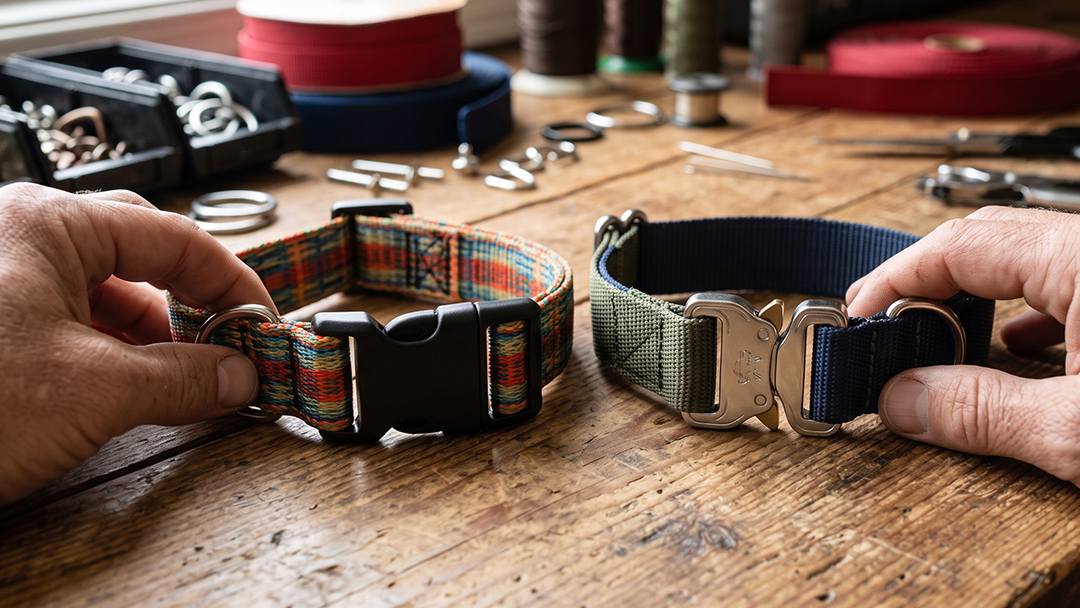
The choice between side release buckles and metal buckles changes how a collar functions day to day, not just how it looks.
Side release buckles are made from plastic, typically nylon or acetal resin. They press together and release with finger pressure on both sides, which makes them fast and convenient for everyday wear. The quality range is wide. Cheap side release buckles go brittle with UV exposure and can crack from sudden stress or just from age. Acetal buckles hold up significantly better because they handle temperature swings and sun exposure without the same degradation. If you're going with plastic, material composition matters more than price point alone.
Metal buckles, whether standard belt-style or quick-release versions, offer greater tensile strength across the board. The tradeoff is weight and a longer setup process. Metal buckles typically require threading the webbing through and folding it back on itself. That takes more time, but it creates a connection that won't fail the way plastic sometimes does under sudden load.
For small dogs and situations where quick removal matters, a quality side release buckle handles the job. For larger dogs, hard pullers, or any working situation, a metal buckle is the more reliable call. Match the hardware to what the dog actually does, not to what looks good in the listing photos.
D Rings: Where the Leash Meets the Collar
spreads across the collar. The D ring absorbs all of it. If it's weak or poorly attached, nothing else about the collar matters.
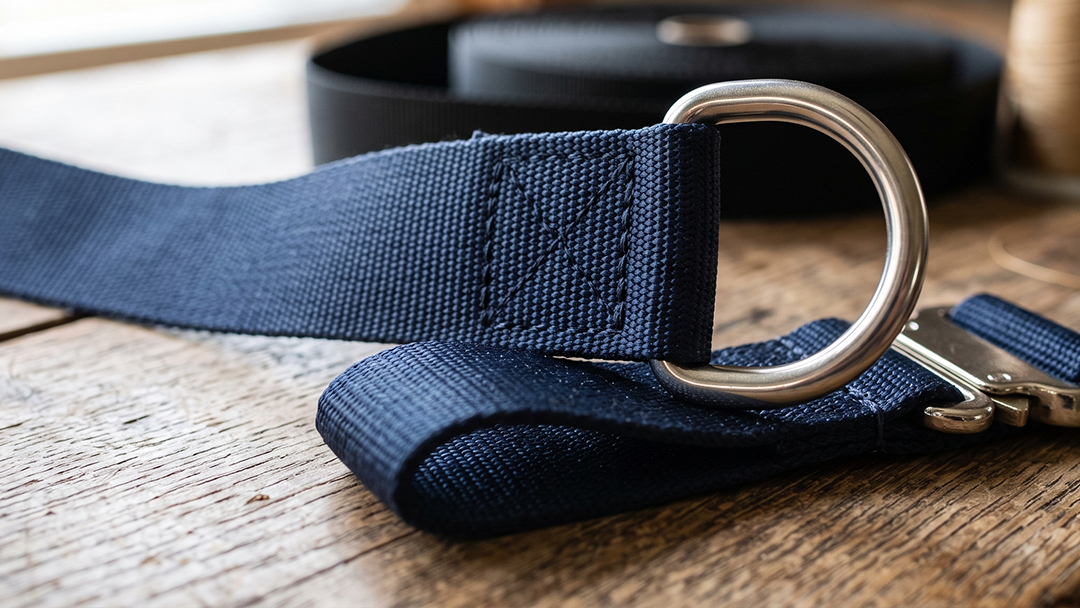
Welded D rings have the seam fully closed and fused. Non-welded D rings have a small gap where the metal ends meet, and that gap is a failure point. Under enough stress, a non-welded ring can open. For any dog that pulls, welded D rings aren't a preference. They're a structural requirement.
How the ring attaches to the collar is just as important as the ring itself. Simply threading webbing through a D ring and stitching it down allows for shifting under load and puts too much stress on too small an area of stitching. A box stitch with an X pattern distributes that force much more effectively.
Material plays a role here too. Steel D rings are strong and cost-effective, but plain steel rusts with repeated water exposure. Stainless steel handles moisture far better. Zinc alloy is lighter and corrosion-resistant but doesn't carry the same load as steel, so for large or powerful dogs it's worth stepping up to steel or stainless. Brass offers good corrosion resistance and a warmer aesthetic, though it can tarnish over time and runs softer than steel.
The welded D rings we carry at Country Brook are sourced with secure leash attachment in mind. We've been around long enough to know what fails in the field, and the gap in a non-welded ring shows up eventually.
Sliders and Keepers: The Often-Overlooked Components
Sliders and keepers are easy to treat as afterthoughts. They're also the parts that make a finished collar feel finished versus something that came off a kitchen table.
A slider needs to fit the webbing snugly. It should be loose enough to move when you adjust the collar and tight enough to hold position after. The center bar is what creates friction against the webbing. Better sliders have smooth, polished interiors that grip without fraying. Cheap sliders sometimes have rough edges or sharp interior corners that slowly damage the webbing, especially on softer nylon materials. You don't see the damage until the webbing starts to fray from the inside out.
Keepers, sometimes called loops, hold the tail of the webbing flat against the collar body. They're usually sewn directly into the collar rather than sliding. Without them, the excess webbing flops around and catches on things. It's a detail that separates a collar that wears well from one that just holds together.
Rivets, Snaps, and Decorative Hardware
Rivets reinforce stress points where hardware meets webbing. They spread force across a wider area than stitching alone, which matters at attachment points that take repeated directional stress.
Setting rivets correctly requires the right tools and some practice. A poorly set rivet pulls out under stress or damages the material around it. Machine-set rivets tend to be more consistent than hand-set ones. If you're making collars to sell, a quality rivet setter pays for itself quickly in consistency. For one-off personal collars, reinforced stitching with a box-and-X pattern may be more practical.
Snaps that appear on collars for tag attachment or accessories follow the same quality logic as everything else. Cheap snaps corrode, stick, and eventually fail. Better snaps operate cleanly and resist corrosion through regular water exposure.
Decorative hardware such as conchos, nameplates, and similar pieces adds character to a collar, but make sure anything you add is secured properly and won't create an irritation or snag point. Heavy pieces that bounce during movement can wear on skin over time. Sharp edges on decorative pieces are worth inspecting before they go anywhere near a dog's neck.
Material Choices and Corrosion Resistance
Steel is strong and affordable but needs protection from moisture. Nickel-plated steel resists corrosion better than uncoated steel and carries a clean, bright finish that holds up well. Stainless steel is the right call for dogs that swim or live in humid climates because it handles moisture without degrading.
Brass has a warm appearance that a lot of makers and customers prefer, and it resists corrosion reasonably well. It will tarnish over time, which some people appreciate as character and others don't. A clear coat slows the process.
Zinc alloy lands in the middle on both cost and performance. It's lighter than steel, corrosion-resistant, and good for most everyday collar applications. For very large or powerful dogs, the load-bearing limits of zinc alloy are worth factoring in. Steel or stainless steel is a safer choice when the forces involved are significant.
Finish affects both aesthetics and long-term appearance. Polished finishes look sharp out of the box. Matte or brushed finishes hide wear and scratching better over time. Black and antique finishes offer a different look but can show chipping more obviously as the collar ages.
A Note for the Intentional Maker
If you're making dog collars as part of a slow craft practice, working through a small batch, choosing materials deliberately, and thinking about who the end customer is, hardware is where that intentionality either holds or falls apart. The choices you make here aren't just technical. They reflect your standards. A collar made with welded hardware, the right material for the dog's lifestyle, and properly finished sliders is a collar that earns trust. That kind of making is worth doing carefully, and it's worth telling customers about when you sell it.
Matching Hardware to Purpose
A ten-pound dog that never pulls doesn't need the same hardware as a seventy-pound dog that hits the end of the leash hard twice a block.
For puppies, lighter hardware fits the scale and the reality that they'll outgrow the collar before the hardware fails anyway. Side release buckles work well here.
For everyday adult dog collars, mid-weight nickel-plated steel or brass balances durability and comfort without adding unnecessary bulk. Welded D rings still apply.
For working dogs, large breeds, or dogs with serious pulling behavior, the hardware needs to match the load. Thicker gauge metal, larger D rings, and metal buckles are where the safety margin lives. This is the category where hardware quality becomes a direct safety consideration.
The same framework applies if you're building collars to sell. Know what your hardware is rated for and be honest with your customers about what their dog's collar is built to handle. Matching hardware to purpose isn't just good design. It's responsible making.
Frequently Asked Questions
What is the difference between welded and non-welded D rings?
Welded D rings have the seam fully closed and fused, which eliminates the gap where metal ends meet. Non-welded D rings have a small opening at that seam that can spread under significant stress. For any dog that pulls on the leash, welded D rings are essential.
Can I use side release buckles for large dogs?
High-quality side release buckles can work for large dogs, but they need to be acetal or equivalent quality, and the dog's pulling behavior matters. Metal buckles provide greater tensile strength and are generally the more reliable choice for larger or stronger dogs.
How do I know what size hardware to use for different webbing widths?
Hardware needs to match the webbing width exactly. One-inch webbing requires one-inch buckles, D rings, and sliders. Mismatched sizing creates weak points, causes hardware to shift, and prevents proper function. Measure before ordering, and double-check when the hardware arrives.
What hardware material is best for dogs that swim frequently?
Stainless steel offers the best corrosion resistance for dogs that spend time in water. Brass also holds up well. Plain steel and low-quality plated hardware will rust with repeated water exposure. It's a matter of when, not if.
Do I need rivets if I'm already using strong stitching?
Strong stitching with a box-and-X pattern handles most applications well. Rivets add a layer of reinforcement at stress points and distribute force across a wider area, which makes them worth using on collars for heavy-use situations or hard-pulling dogs.
Troy has helped CBC support their community of makers, crafters, sewers, small businesses, and DIYers from the Moulton, Alabama shop for over 15 years.


