 Our offices will be closed Monday, September 7th for Labor Day. Orders can still be placed online, and both customer service and shipping will resume Tuesday, September 8th.
  Review and Win! Share your verified review and get a chance to win a $25 store credit!
Choosing the Right Webbing for Dog Harnesses
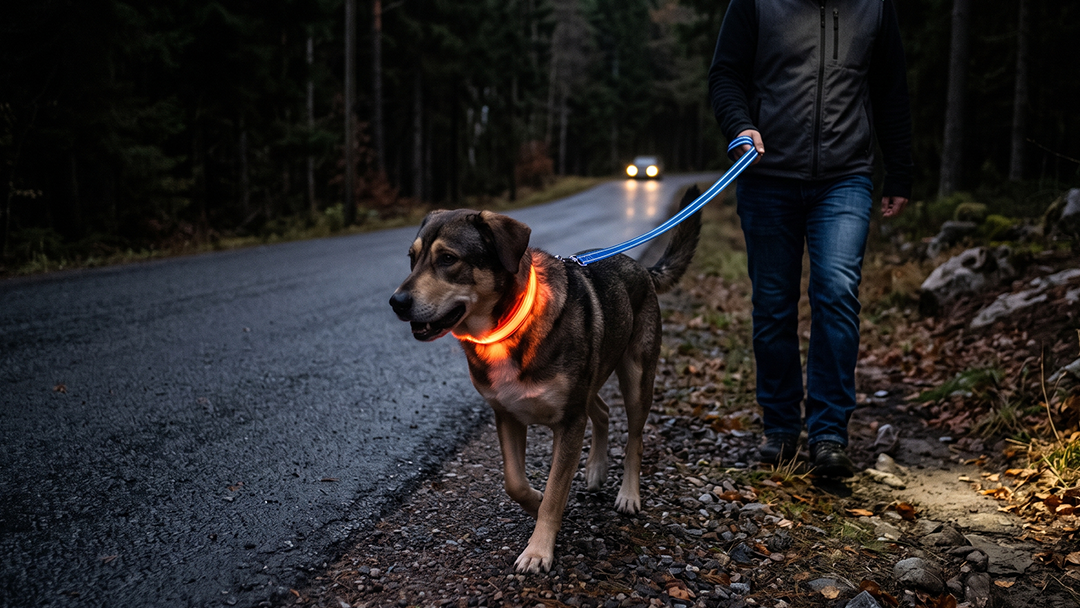
The most obvious hazard of night walking is traffic, but that's only part of the picture. Other pedestrians, cyclists, and people walking their own dogs all need to see you from far enough away to make decisions. They need time to move aside, slow down, or manage their own animals. That reaction time disappears fast when nobody's visible until the last second.
Think about two dogs meeting unexpectedly on a dark path. Without enough warning, both animals can startle, and their owners have almost no time to read the situation and respond. A few extra seconds of visibility can be the difference between a calm pass and a tangle.
Reflective gear addresses this, but the cheap reflective strips on most standard collars are narrow, angle-dependent, and minimal. Real visibility means gear that catches light from multiple directions and creates a clear outline of both you and your dog. Your own visibility is just as important as your dog's. A driver might spot a reflective flash at ankle level and still not understand that a person is connected to it by a leash until they're already past you.
Choosing the Right Leash for Night Walks
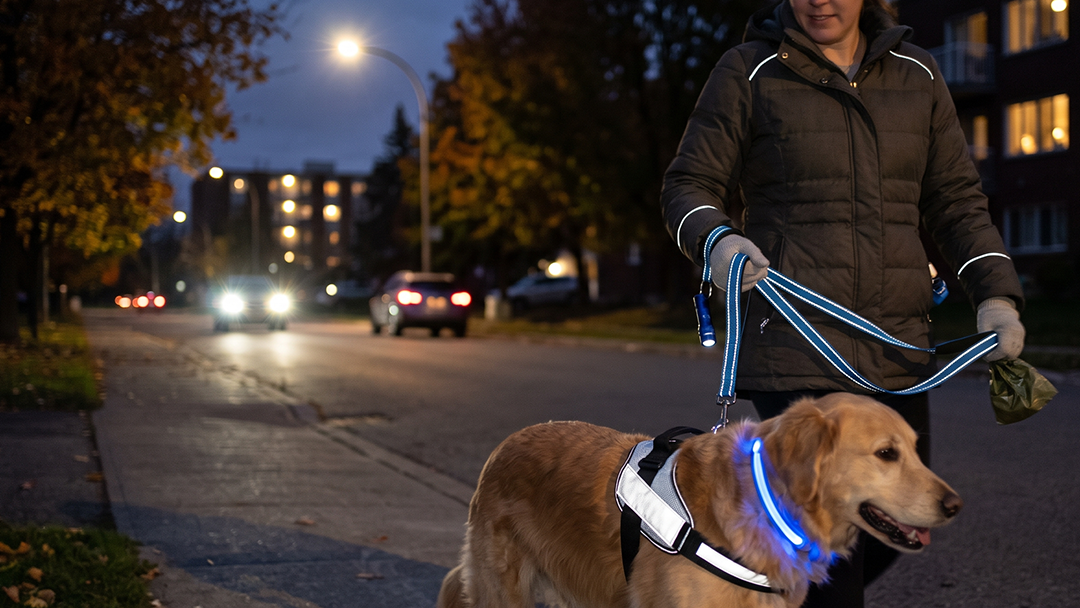
The leash you grab every morning may not be the right tool after dark. At night, a leash is doing more than keeping your dog close. It's a safety line in conditions where you can't see everything around you and where your reaction time depends entirely on what's in your hand.
Length is one of the first things to reconsider. Retractable leashes are a genuine hazard after dark. The cord is nearly invisible to drivers and cyclists, and the extended length works against you when something appears suddenly and you need immediate control. A standard four to six-foot leash keeps your dog close enough to manage and close enough to actually see their body language, which matters more at night than most people realize.
Material and construction become critical precisely because you're depending on that leash more heavily when visibility is low. A sudden lunge toward something you didn't notice requires a leash that holds without hesitation. Nylon and biothane both offer solid strength, but construction quality varies a lot. Reinforced stitching at stress points and reliable hardware aren't optional features. They're the baseline.
CB Petz has been sourcing and stocking webbing and hardware for over two decades. The team knows what holds and what doesn't, and that background shapes which products end up on the shelves. When a leash is being used in low visibility conditions where a failure could mean losing your dog in the dark, that sourcing judgment matters.
Reflective stitching or trim on the leash itself adds another layer of clarity. Even a modest amount helps drivers and other pedestrians understand the connection between you and your dog, which makes your movement more predictable and reduces the chance of an unexpected close call.
Managing Your Dog's Behavior When Senses Are Limited
Dogs see better in low light than we do, but darkness still changes the dynamic of a walk in ways that affect both of you. The subtle body language signals that tell you what your dog is feeling, including leash tension, posture shifts, and a quick glance back, are harder to catch when you're also watching for curbs, cars, and gaps in the sidewalk.
That slight forward lean that usually tells you another dog is nearby? You might feel it a half-second later than you would in daylight. The stiffening that warns you something has their attention? Nearly invisible in poor light. This is a practical argument for well-lit routes, not just for your visibility to others, but so you can actually see your dog and read what they're telling you.
Work on voice commands if your dog currently relies partly on visual hand signals. At night, "leave it," "heel," and "sit" become your primary tools because you're operating with less visual information about what they're reacting to. The more reliable those verbal responses are, the more control you have in situations you can't fully see.
Keep night walks structured. Stick to familiar routes where you know the terrain, the traffic patterns, and where other dogs tend to appear. New neighborhoods on a Tuesday night in December are not the time to explore.
Route Planning and Environmental Awareness
A route that works fine at noon can present real problems after dark. Uneven sidewalks become tripping hazards. Poorly lit intersections become genuinely dangerous crossings. Parks that feel comfortable during the day have different populations after dark. Your night route should be a deliberate choice, not just the path you default to out of habit.
Stick to sidewalks and streetlights, even if it adds time. The few extra minutes are consistently worth it. Understand the traffic patterns at the specific hour you're walking. Evening rush hour means distracted, tired drivers moving fast. Late-night hours mean fewer cars but potentially less alert ones.
Pay attention to surfaces. Wet pavement and dry pavement are indistinguishable in poor light. Gravel that's easy to navigate in daylight becomes unstable when you can't see where you're stepping. Ice, wet leaves, and standing water hide effectively in the dark. Know your route well enough to anticipate where these hazards tend to appear.
Plan for situations where you need to step aside quickly. Know where the wider sections of sidewalk are and where you can easily move if an off-leash dog approaches or a car drifts too close. Having those options already in mind means you're not problem-solving from a standstill.
Building a Safety-First Mindset for Night Walks
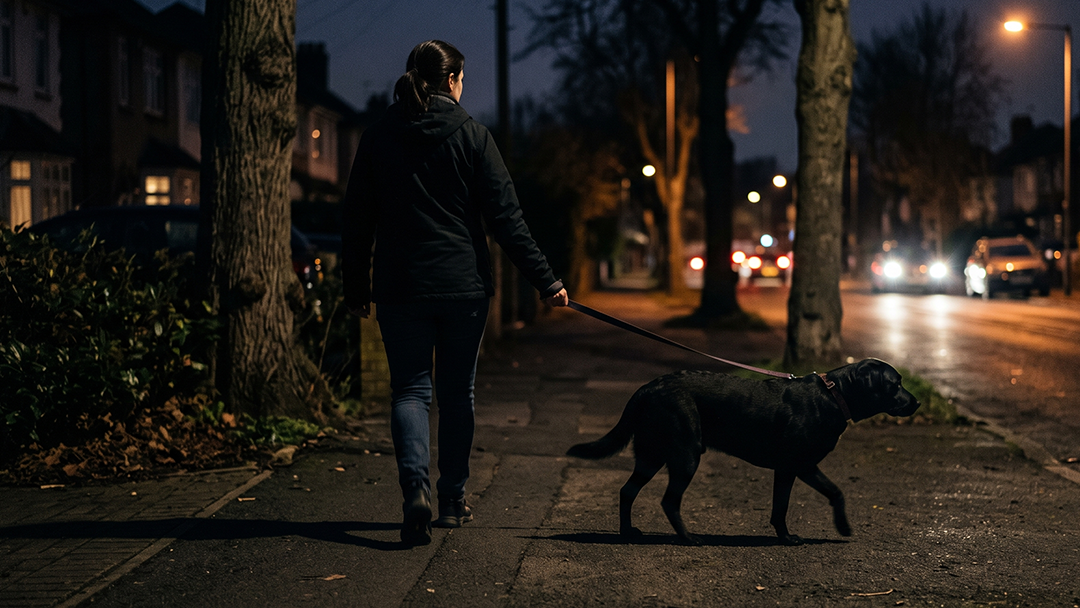
Equipment and route planning only go so far. After dark, the most useful thing you can carry is realistic awareness of what's actually different and why it requires a different level of attention.
Trust your read on situations that feel off. If a street is darker than you expected, take a different one. If something about an approaching person or dog makes you uncomfortable, cross early. Your dog picks up on your stress and responds to it, which creates a feedback loop that makes both of you less steady. Crossing the street isn't a failure of nerve. It's a decision.
Keep your phone charged and on you, even for a walk around the block. It's easy to skip this on short routes, and it's exactly the kind of shortcut that matters on the one night something goes sideways.
Walking with a partner helps when you're in less familiar areas or going out late. Two sets of eyes catch hazards faster, and there's practical value in having someone nearby if either of you or the dogs needs help.
For longer or later walks, let someone know your route and when to expect you back. This doesn't need to be elaborate. A quick text with a general path and a return time is enough. It's a simple safety net that costs almost nothing.
And it is entirely okay to skip a walk or cut one short when conditions are genuinely unsafe. Heavy rain that reduces visibility to near zero, icy pavement, or a situation where you simply don't feel right about heading out are all valid reasons to go back inside and let your dog burn energy a different way. The walk will happen tomorrow.
Frequently Asked Questions About Night Dog Walking
What type of collar or harness is best for night walks?
Look for collars or harnesses with substantial reflective material that's visible from multiple angles, including front, back, and sides, not just a narrow strip on top. LED clip-on lights add meaningful visibility on top of reflective material. Fit matters too. A spooked dog in the dark can back out of a collar that's even slightly loose, so make sure it's properly adjusted before you go out.
How can I tell if my dog is anxious during night walks?
Watch for pacing, tail tucking, excessive panting, reluctance to move forward, or persistent pulling toward home. If your dog shows consistent anxiety on night walks, start shorter with better-lit routes and build from there. A headlamp pointed at your dog occasionally lets you actually see their face and posture, which makes a real difference in catching stress signals early.
Is it safer to walk on the road or sidewalk at night?
Sidewalk whenever one is available. If you're on a road without sidewalks, walk facing traffic so you can see what's coming, stay as far to the side as safely possible, and wear reflective clothing. Don't assume drivers see you even if you're lit up.
Should I let my dog off-leash in a dark park?
No. Even in spots where off-leash activity is normally fine, darkness introduces too many variables you can't manage. You can't see hazards, other animals, or approaching people until they're very close. Your dog can also become disoriented if they get distracted and move out of your sight line, and getting them back under those conditions is much harder than it should be.
What should I carry on night walks besides a leash?
A flashlight or headlamp, your phone, waste bags, and some high-value treats for managing unexpected dog encounters are the core. A whistle is worth having for emergencies. For walks longer than 20 minutes, especially in warmer weather, bring water. A small first-aid kit makes sense for longer routes.
Troy has supported CB Petz's community of makers, crafters, sewers, small businesses, and DIYers from the Moulton, Alabama shop for over 15 years.


