
D Rings vs Triglides: Key Differences and Uses
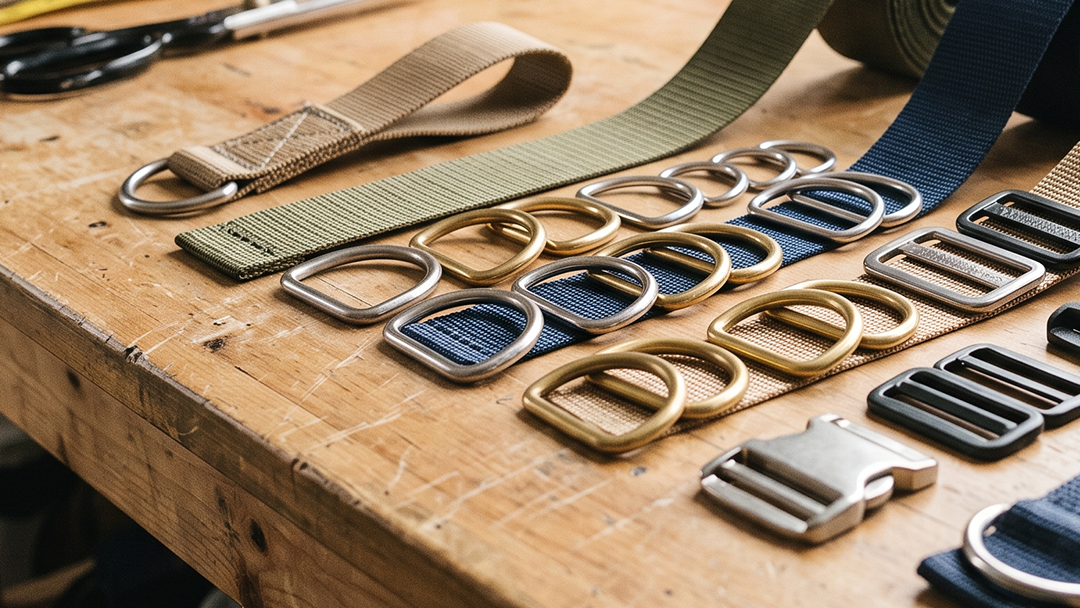
A customer came into our Moulton shop not long ago with a half-finished dog harness in hand and a frustrated look on her face. She'd sewn everything together beautifully, but the adjustment point kept slipping every time her dog hit the end of the leash. The problem wasn't her sewing. It was that she'd used a D ring where a triglide needed to be. One swap, and the whole thing worked exactly the way she'd planned.
That kind of mix-up happens more than you'd think, and it's not because people aren't paying attention. It's because D rings and triglides look like they belong to the same family of hardware, and in a lot of ways they do. But they solve completely different problems. Grab the wrong one at the start of a project and you might not find out until you've already sewn everything down.
Here's how to tell them apart and, more importantly, how to know which one your project actually needs.
What Is a D Ring?
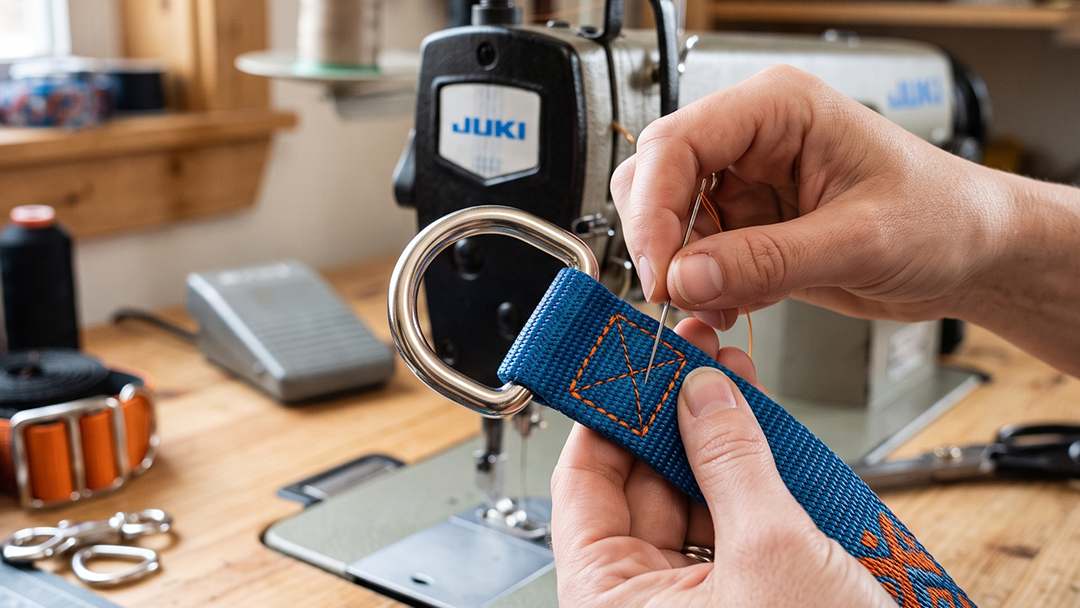
The name is literal: a D ring is shaped like the letter D. The flat bar gives you a fixed point to sew your webbing around, and the curved portion stays open to accept a clip, snap hook, carabiner, or another piece of hardware. The whole point of a D ring is that it stays put. It's an anchor.
When you fold webbing over the flat bar and stitch it down, that connection is only going to move if your thread gives out or your webbing fails. The D ring itself isn't meant to slide or adjust anything. It's meant to hold.
D rings come in welded and unwelded versions. Welded D rings have the metal fused at the joint, which closes the gap and removes the weak point. Unwelded D rings have a small opening where the ends meet, which makes threading onto webbing easier but leaves them better suited to lighter, low-stress applications. For anything that's going to take real pull, a welded D ring is the one to reach for.
What Is a Triglide?
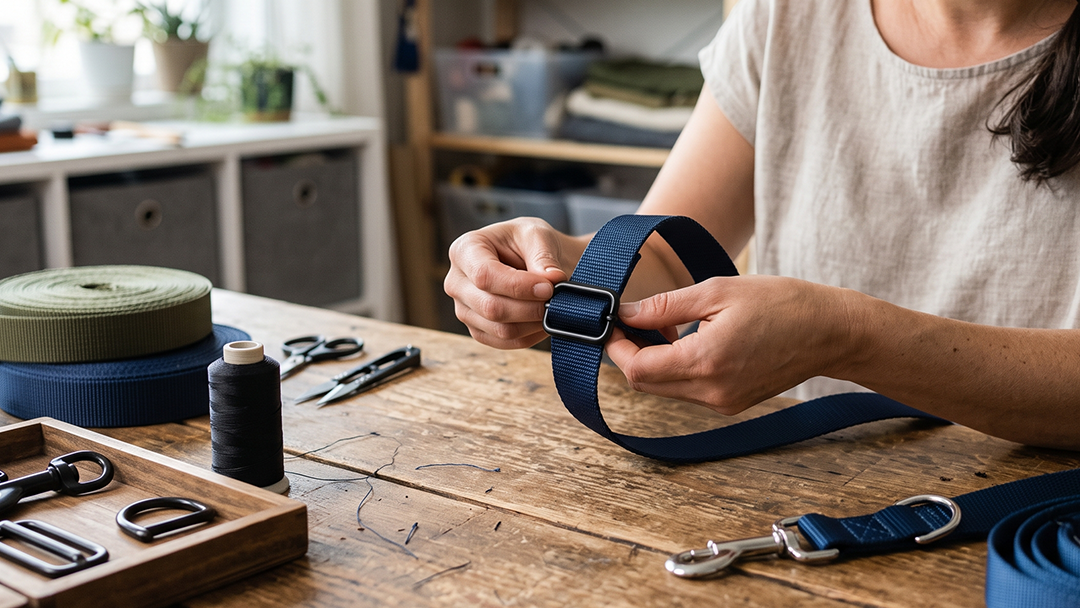
A triglide is a rectangular piece of hardware with three bars, which is exactly where the name comes from. The two outer bars form channels that webbing passes through, and the center bar is fixed. When you thread webbing through one channel, around the center bar, and back out the other channel, the doubled-up material creates friction against itself. That friction is what holds your strap at the length you've set.
When the strap is under tension, the webbing presses against the center bar and against itself, and that pressure keeps everything in place. Let the tension off and you can slide the triglide to adjust the length. It's a simple mechanical principle, and when it's matched to the right webbing and the right project, it works reliably for years.
Threading matters here more than most people expect. If the webbing goes through in the wrong direction or doesn't make a proper loop around the center bar, the friction doesn't build the way it should and the strap will creep. Take an extra minute to thread it correctly the first time.
When to Use a D Ring
Any time you need a fixed, load-bearing connection, reach for a D ring. The flat bar gives you a clean sewing point, and the open curve gives you a permanent connection point for whatever comes next.
Dog collars are a classic application. The D ring handles the jerk load when a dog hits the end of a leash, and it allows the leash clip to rotate without twisting the collar against the dog's neck. Bag construction uses D rings to attach adjustable shoulder straps to the bag body at reinforced anchor points. Harnesses, belts, and outdoor gear all rely on D rings for exactly the same reason: you need something to stay put under force.
D rings also make modular systems possible. Because the curved side stays open, you can attach and detach hardware without undoing any sewn connections. That's useful any time you're building something designed to be reconfigured.
For lightweight or decorative applications, an unwelded D ring does fine. For anything that's going to be pulled on, loaded, or used outdoors, spend the extra bit on the welded version. It's worth it.
When to Use a Triglide
If the length of a strap needs to be adjustable, a triglide is the right piece of hardware. Bag straps that need to fit across different body sizes, pet collars that need to be fitted at home rather than in a shop, camera straps, apron ties, tool belts - all of these benefit from the quick adjustability a triglide provides.
One thing we say consistently in the shop: the hardware size has to match the webbing width exactly. A 1-inch triglide goes with 1-inch webbing. If the triglide is too large, the webbing slides through without enough friction to hold. If it's too small, the webbing won't fit through the channels at all. This is one of the most common reasons triglides fail, and it's completely avoidable.
Triglides work on friction, not on a mechanical lock. That's a meaningful distinction. For applications where safety depends on the connection holding under continuous heavy load, a triglide alone may not be sufficient. In those situations, it's worth combining the triglide with a sewn backup or a buckle system, or rethinking the hardware choice entirely.
Combining D Rings and Triglides
Most well-designed adjustable strap systems use both. A typical bag strap might anchor to the bag body with D rings sewn into reinforced webbing, run through a triglide in the middle for length adjustment, and reconnect to the other side of the bag through another set of D rings. The D rings carry the load at the fixed points, and the triglide handles the fit.
This combination works because each piece is doing what it was designed to do. The D rings aren't being asked to slide, and the triglide isn't being asked to serve as a permanent anchor. When hardware is used in the right role, projects hold up far better over time.
We've seen both mistakes made plenty of times over the years here in Moulton. D rings used where triglides were needed result in straps that can't be adjusted, and triglides used as anchor points creep and slip under load because that's not what they're built for. Both are easy to avoid once you understand the difference.
A Note for Slow Makers and Fiber Artists
If you're someone who thinks carefully about the materials that go into your work, hardware is worth the same attention you give to your webbing or thread choice. A well-chosen D ring or triglide becomes a functional part of the object's life. It's what keeps a hand-sewn bag working the way it should five years from now, or what makes a hand-crafted dog collar something a customer trusts completely. The time spent understanding your hardware is part of the making process, not separate from it. That's something we've always believed at Country Brook, and it's one reason we carry a range of finishes, sizes, and materials rather than a single "good enough" option.
Choosing the Right Hardware for Your Project
Before you cut a single piece of webbing, sketch out the project and mark every hardware point. Note which ones need to be fixed, which ones need to allow adjustment, and which ones need to handle significant load. That simple exercise usually makes the D ring and triglide placement obvious.
Material matters too. Nylon webbing, polypropylene, and cotton all have different surface textures and different behaviors with triglides. Slicker materials can reduce the friction a triglide depends on, so you may need to size down slightly or test before you commit. D rings are less sensitive to this, but you still want the ring width to match your webbing for a clean result.
Finish is worth thinking through as well. Nickel-plated hardware is a solid choice for indoor projects and everyday use. For anything going outside, such as pet gear, outdoor bags, or marine applications, stainless steel resists corrosion in ways that plated finishes simply don't over time. We stock all of these because the right finish for a weekend hiking pack is different from the right finish for a camera bag that lives in a climate-controlled studio.
At Country Brook Craft Supply, we carry D rings and triglides across a full range of sizes, finishes, and materials, and we've been doing it long enough to know what holds up and what doesn't. If you're not sure what you need, that's a real question with a real answer, and we're happy to help you find it.
Frequently Asked Questions
Can you use a D ring instead of a triglide for adjustable straps?
No. A D ring will let webbing pass through it, but it won't hold the strap at an adjusted length. Triglides are specifically built with a center bar that creates friction when webbing loops around it. That friction is what keeps the adjustment in place under load. A D ring doesn't replicate that.
What size triglide do I need for 1-inch webbing?
A 1-inch triglide. Hardware size should always match webbing width. Too large and the webbing slips without building friction. Too small and the webbing won't fit through the channels. This is one of the first things to confirm before you start a project.
Are welded D rings stronger than unwelded D rings?
Significantly. The weld closes the gap where unwelded D rings simply meet, which removes the weakest point in the hardware. For load-bearing applications such as leashes, harnesses, and bag straps that carry weight, welded D rings are the right choice.
Why does my triglide keep slipping even when threaded correctly?
Usually it comes down to a mismatch between the hardware size and the webbing width, or a webbing material that's too slick to generate adequate friction. Check that the triglide size matches the webbing exactly, and consider whether the material itself has enough surface texture to hold.
Can you sew through a triglide to make it permanent?
You can, but you're better off not. If you need a fixed-length connection, sew the webbing directly or use a D ring as your anchor point. Triglides are built for adjustability. Making them permanent usually means you should have used different hardware to begin with.
Troy has helped Country Brook Craft Supply support their community of makers, crafters, sewers, small businesses, and DIYers from the Moulton, Alabama shop for over 15 years.


