
Webbing Hardware 101: Essential Guide for Strap Projects

Side Release Buckles
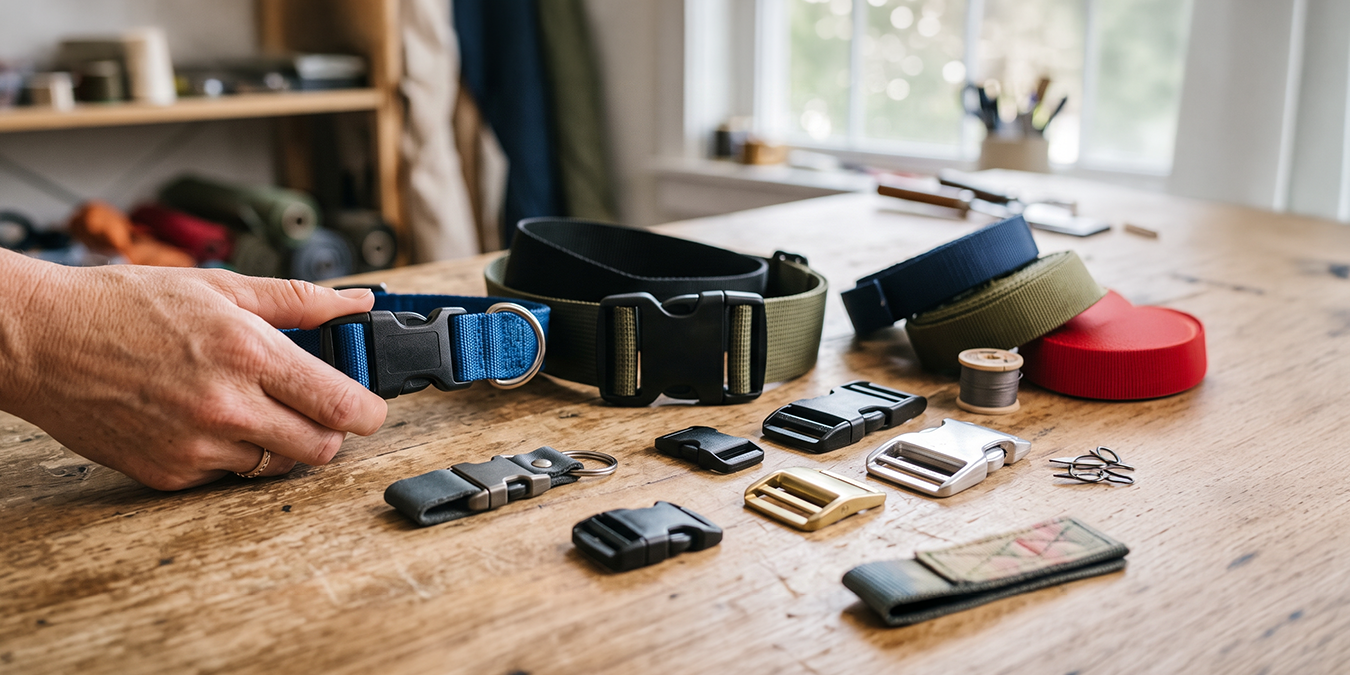
Side Release Buckles are the workhorses of adjustable strap work. You've used them without thinking about it on a backpack chest strap, a dog collar, or a piece of luggage. The male end clicks into the female end, and you squeeze the sides to release it. Simple mechanism, reliable when matched to the right application.
The main advantage is speed. Nothing else gives you faster on-and-off access. That's why they show up on dog collars, bag sternum straps, and any strap that needs to be put on and removed repeatedly throughout the day.
Material grade matters more than most people expect. Entry-level plastic can crack under UV exposure or in sustained cold. Better-grade plastic, the kind used in quality outdoor gear, holds up through years of temperature swings and repeated stress. Metal side release buckles are available for applications where plastic simply won't hold up. They're heavier and cost more, but for heavy-duty work or extreme conditions, that tradeoff is usually straightforward.
Sizing is simple: match the buckle width to your webbing width. A 1-inch buckle fits 1-inch webbing. Forcing webbing through hardware that's even slightly undersized creates a stress point right where you don't want one, and it accelerates wear faster than almost any other mistake you can make.
Tri-Glide Slides
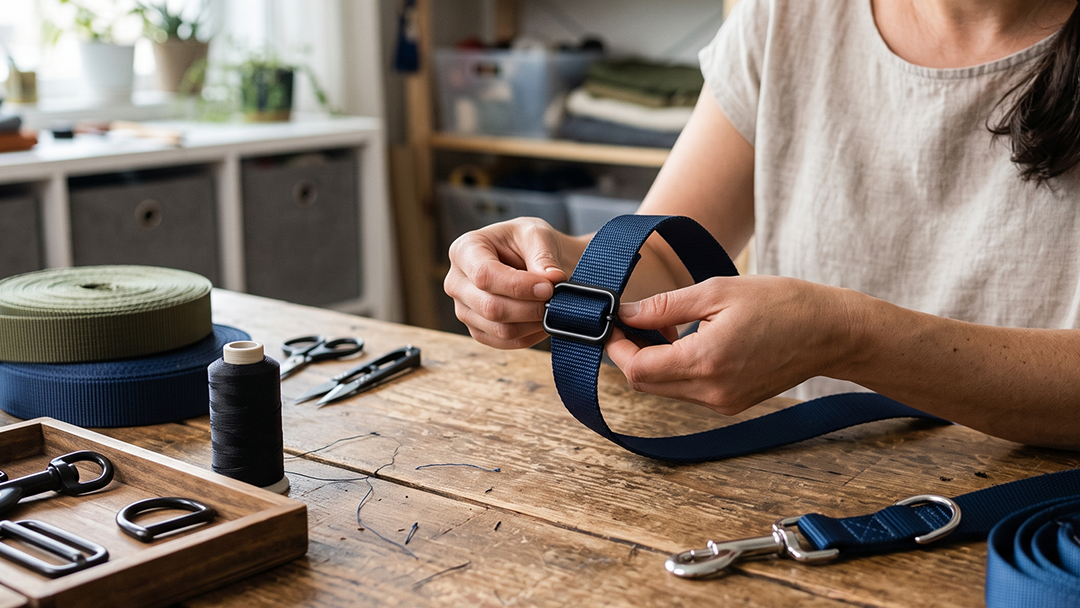
Tri-Glide Slides are about as minimal as hardware gets. A rectangular frame, a center bar, and two openings. You thread webbing through the frame, over the center bar, and back through the frame. Pulling the free end tightens the loop, and friction against the center bar holds the adjustment.
What makes tri-glides worth knowing well is their profile. They add almost no visual or physical weight to a project, which makes them a natural fit for bag straps, camera straps, and shoulder straps where clean lines matter. A good tri-glide disappears into the strap and just does its job.
The limitation is that they rely on friction, which means they work best under moderate tension. They're not meant for applications where you're adjusting under a heavy load or where the webbing needs to hold tight against serious pull. Polypropylene webbing is slicker than nylon, and that reduced friction can cause slippage in tri-glides under higher tension. This is something worth accounting for at the design stage rather than after the fact.
Plastic tri-glides are lightweight and inexpensive. Metal versions, usually steel or brass, hold adjustment better under greater tension and last longer in heavy-use applications.
D-Rings and O-Rings
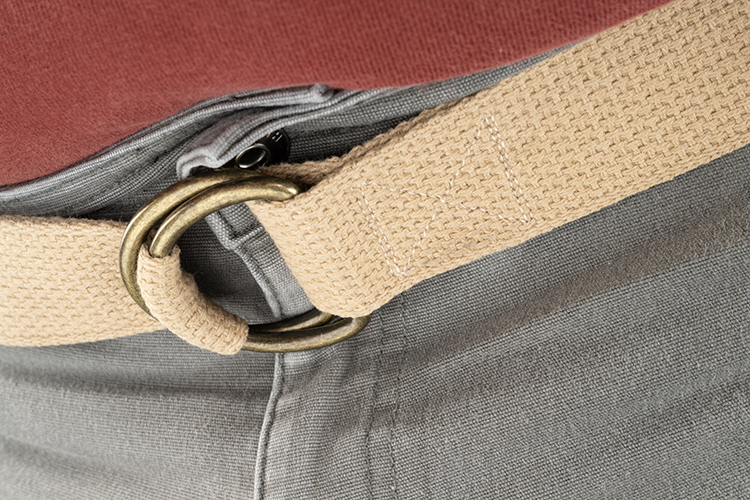
D-Rings and O-Rings show up on leashes, bag straps, belts, and harnesses. Webbing passes through the ring and gets sewn back onto itself, creating either a fixed or sliding attachment point. The ring gives you somewhere to clip, hook, or anchor.
The shape difference between D-rings and O-rings has a functional reason. The straight side of a D-ring is where stress concentrates during load, and that geometry distributes force more efficiently than a circle. For most attachment applications, D-rings are stronger for their size than O-rings. O-rings, on the other hand, allow connected hardware to rotate freely in any direction, which is exactly what you want on a leash where you need the clip to move naturally rather than fighting the animal's movement.
Construction matters more than most people realize. Welded rings are bent from a single piece of metal and welded closed, which means no seam to fail under stress. Cast rings are poured into a mold, and while quality cast rings are adequate for most projects, welded rings carry more consistent strength ratings for anything that will see real load.
For material: steel is strong and affordable, brass resists corrosion well, aluminum cuts weight at some cost to strength, and stainless steel offers both strength and corrosion resistance if budget allows.
Swivel Snaps and Trigger Snaps
Swivel Snaps and Trigger Snaps let you attach and detach webbing from an anchor point without tools, threading, or permanent commitment. Leashes, lanyards, key straps, and tethers all depend on them.
The customer with the twisted leash was using a trigger snap, which has a spring-loaded gate that pulls a small lever to open. It's solid and reliable. What she needed was a swivel snap, which has a rotating base that allows the snap to spin independently of the webbing. That rotation prevents the twist from building up in the first place.
For anything that gets pulled in multiple directions, especially dog leashes, swivel snaps are almost always the better call. For fixed applications where the strap stays in a consistent orientation, trigger snaps are simpler and often less expensive.

Size matters here. An oversized snap adds weight and bulk that doesn't serve the project. An undersized snap may not have the strength rating you actually need. The right approach is to match snap size to webbing width and to think through the expected load before ordering rather than after.

Cam Buckles and Ladder Locks
Cam Buckles and Ladder Locks are built for a specific job: creating and holding tension. You'll find them on cargo tie-downs, securing straps, and anywhere you need to cinch webbing tight and trust it to stay there.
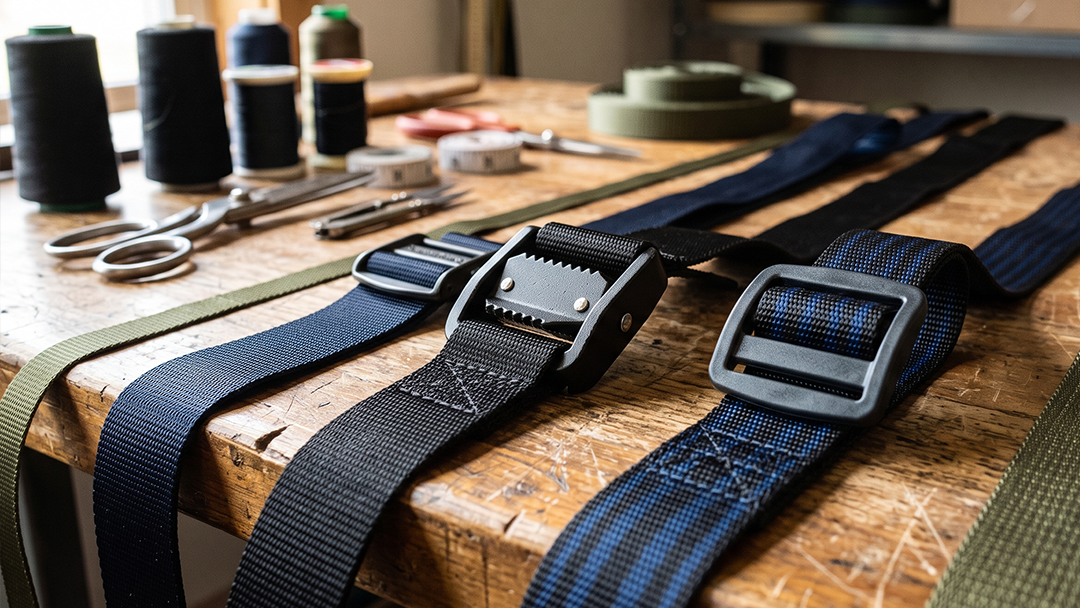
Cam buckles use a spring-loaded cam that grips the webbing as tension is applied. Thread the webbing through, pull it tight, and the cam locks it down. To release, lift the cam and feed the webbing back. They hold well under heavy load, which is why they're the standard choice for serious cargo applications.
Ladder locks, sometimes called tribar slides, work through a different mechanism. They use two parallel bars with a third bar across the center. Thread the webbing through, over the middle bar, and back through, then pull the free end to lock. They're lighter and simpler than cam buckles, but they can slip under extreme tension if the webbing has a particularly smooth surface.
If you're building anything meant to secure gear, luggage, or cargo, one of these two is the hardware you're looking for.
Choosing Hardware Based on Real Use
The question to work backward from is always: what does this finished piece actually need to do?
- Does it need to be adjusted frequently, or set once and left alone?
- Will it be under constant tension or occasional load?
- Does the user need to connect and disconnect it multiple times a day?
- Does weight matter?
- Will it be outside in sun and weather?
- What kind of daily tension is realistic?

A dog leash needs a swivel snap because dogs are unpredictable. A camera strap benefits from tri-glides because low profile matters and the load is moderate. A cargo strap needs a cam buckle because there's no substitute for real tensioning capability when you're securing something in a truck bed.
Matching hardware to function, rather than to aesthetics or what happened to be in stock, is what separates projects that hold up over years from ones that fail at exactly the wrong moment. At Country Brook, the range of hardware options we carry exists because those functional differences are real, and different projects genuinely need different solutions.
For the Makers Who Think About the Whole Thing
There's a specific kind of maker who reads the whole spec sheet before ordering anything. They're thinking about weight distribution, long-term wear, and what the hardware will look like after two years of daily use instead of two weeks. They're building a bag that will last a decade, or a leash that will outlive a dozen cheaper ones from a big box store.
If that's how you approach your work, the hardware choices above aren't just functional decisions. They're part of the integrity of the finished piece. Welded steel over cast. Metal over low-grade plastic for anything that will see real stress. Hardware width matched exactly to webbing width, every time. These aren't fussy details. They're what makes the difference between something that holds and something that doesn't, and for makers who care about that distinction, it's worth getting right from the start.
Avoiding Common Hardware Mistakes
The most common mistake is choosing hardware that's too light for the actual load. A lightweight plastic buckle can look clean and proportional on a project, but if daily use puts real stress on it, it will fail eventually, usually at a bad time. Metal costs more and adds weight, but for applications that demand durability, it's the honest choice.
The second mistake is mixing incompatible widths. Even a quarter-inch mismatch creates stress points and accelerates wear in ways that aren't always obvious until the hardware starts to fail. Match width to width, exactly.
And don't assume that all plastic is the same or that all metal is the same. Material quality varies significantly across the hardware market. Low-grade plastic becomes brittle and cracks with UV exposure. Low-grade metal corrodes or bends under stress before it should. Better hardware costs a little more upfront and doesn't fail in the middle of a project's useful life.
Frequently Asked Questions
What’s the difference between plastic and metal hardware for webbing projects?
Plastic hardware is lighter and less expensive, which makes it appropriate for projects where weight matters and loads are moderate. Metal hardware offers greater strength and durability, particularly for heavy use or exposure to extreme conditions. A lightweight camera strap can work well with quality plastic hardware. Heavy cargo straps need metal.
How do I know what size hardware to use with my webbing?
Match the hardware width exactly to your webbing width. 1-inch webbing uses 1-inch hardware. Undersized hardware creates stress points and accelerates wear. Oversized hardware adds unnecessary bulk. Most hardware is labeled with compatible webbing width, which takes the guesswork out.
Can I use the same hardware for nylon and polypropylene webbing?
In most cases, yes, as long as the width matches. The practical difference is that polypropylene is slicker than nylon, which affects how well friction-based hardware like tri-glides holds under tension. For high-tension polypropylene applications, cam buckles or ladder locks tend to be more reliable than simple slides.
What’s the strongest type of buckle for heavy-duty projects?
For heavy-duty work, metal cam buckles and metal side release buckles offer the most strength. Welded steel D-rings are extremely strong for fixed attachment points. The right choice depends on whether you need quick release, adjustability, or a fixed anchor. It’s also worth thinking through both the hardware strength rating and the webbing strength together, so neither one becomes the weak point.
How do I prevent hardware from sliding on the webbing?
For friction-based hardware, threading technique matters. Make sure the webbing wraps correctly around the center bar with enough contact to generate real friction. For fixed hardware placement, box stitches through the webbing and around the hardware will anchor it permanently. Using webbing with a bit of texture rather than a very smooth, slick surface also improves friction performance across most slide-based hardware.
Troy has helped Country Brook Craft Supply support a community of makers, crafters, sewers, small businesses, and DIYers from the Moulton, Alabama shop for over 15 years.


