
How to Choose the Right Buckle for Your Webbing

A customer came into our Moulton shop a few years back with a half-finished bag project and a frustrated look. She'd ordered buckles online, eyeballed the size, and ended up with hardware that technically fit her webbing but wouldn't stay locked under any real tension. She'd already sewn half the bag. What should have been a satisfying finish turned into an unstitching session on the shop floor.
That kind of thing happens more than people expect. Buckles look interchangeable until they aren't. And once you've sewn, riveted, or glued everything together, a buckle mismatch is a genuinely miserable problem to fix.
After more than two decades of selling webbing and hardware out of Moulton, Alabama, we've had a lot of those conversations. Here's what we actually tell people.
Understanding Load Requirements
Before you think about style, think about force. Not in an abstract way, but in a specific, honest way about what your project will actually do.
A dog leash absorbs sudden jerks. A backpack strap holds steady weight across hours of wear. A cargo tie-down faces vibration, side loading, and the kind of stress that static pull tests don't fully capture. These are different problems, and they need different hardware.
Buckle ratings typically list breaking strength, which sounds reassuring until you realize that number represents a single catastrophic pull under ideal lab conditions. Working load is the number that matters for daily use, and it's considerably lower. A reliable working rule: choose a buckle rated for at least three times the maximum force your project will regularly face. If a strap holds 50 pounds in use, look for a buckle rated to 150 pounds minimum. That margin accounts for wear, UV degradation, repeated stress, and the unpredictable ways things actually get used.
Metal buckles generally handle higher loads than plastic, but that's not a universal truth. Acetyl and high-quality nylon buckles can be surprisingly strong in the right application. Width matters too. A 1-inch buckle and a 2-inch buckle of the same style will not perform the same way, even if both are rated identically on paper.
For anything involving safety, climbing, load-bearing lifting, or securing cargo where failure creates real risk, don't estimate. Use hardware that's rated and certified for those applications specifically.
Side Release Buckles for Quick Access
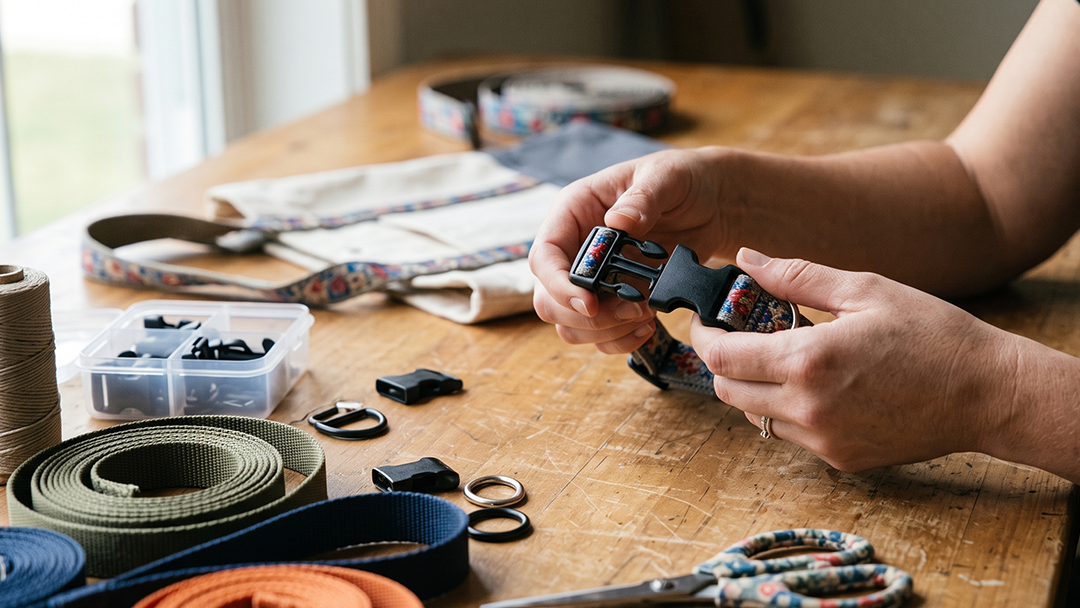
Side release buckles are what most people picture when they think about modern webbing hardware. Press the side tabs, and the buckle opens. Push the male end into the female end, and it clicks closed.
They're excellent when quick, repeatable fastening matters: dog collars, backpack sternum straps, camera bags, gear belts, and anything that benefits from one-handed operation. We move more side release buckles out of this shop than any other style, which tells you something about how many projects need that kind of fast, reliable connection.
The honest tradeoff is that side release buckles aren't built for continuous length adjustment. They hold or release, but fine-tuning length once they're closed isn't their strength. For projects where you set the length once and live with it, they're excellent. For projects that need frequent micro-adjustments, they feel limiting in a way that gets annoying fast.
Plastic quality is not uniform across suppliers. The difference between a buckle that cracks after a summer in the sun and one that lasts years is in the polymer, the wall thickness, and the design of the locking mechanism. Curved versions sit better against the body for anything worn for extended periods. Flat versions pack more cleanly.
Cam Buckles for Adjustable Tension
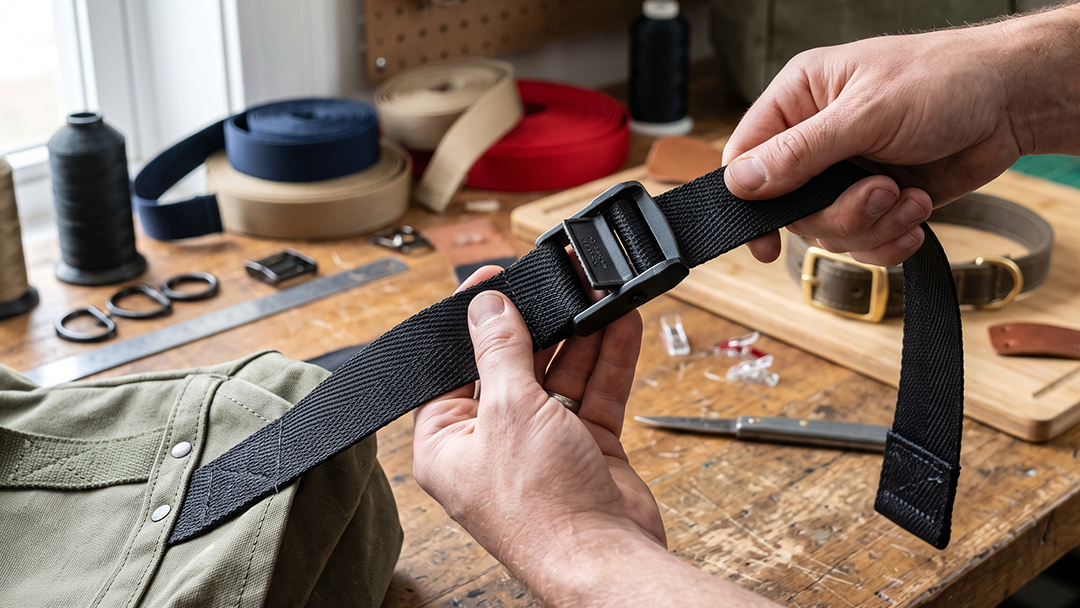
Cam buckles use a toothed cam mechanism to grip webbing and hold it at whatever tension you set. Feed the webbing through, pull it tight, and the cam locks it in place. To release, lift the cam and feed the webbing back through.
These are workhorses for tie-downs, cargo straps, and any situation where you need to cinch something down and adjust it regularly. They don't require a sewn loop or a secondary hardware piece to function. That simplicity is most of their appeal.
The limitation is that cam buckles depend on friction between the teeth and the webbing surface. Smooth or slippery webbing can give the cam less to grip. Worn webbing does the same thing. The webbing also needs enough free length to thread through the mechanism, which affects how you design the finished piece. If your project doesn't leave room for that extra webbing tail, a cam buckle becomes awkward before it becomes useful.
They handle moderate loads well. For heavy-duty applications or high-vibration environments, look elsewhere.
Ladder Lock Slides for Fixed-Length Adjustment
Ladder lock slides, sometimes called tri-glides or slide adjusters, let you dial in a strap length and hold it there through friction. They're lower profile than most buckle hardware, which matters when bulk is a real concern.
These work well for shoulder straps, bag handles, and any application where occasional length adjustment is needed but the strap doesn't need to come apart. You thread the webbing through in a specific pattern, and friction does the rest.
The thing worth understanding about ladder locks is that they require correct threading to hold. Threaded wrong, they slip. It's not complicated, but it's also not intuitive on first encounter. If you're making something that another person will adjust without instruction, that's a consideration.
Parachute Buckles and Center Release Buckles
Center release buckles use a central button or lever to open rather than side tabs. They tend to sit flatter, distribute stress more evenly across the buckle body, and are often easier to operate with gloved hands or in cold conditions.
You'll see these most often in tactical gear, some climbing applications, and projects where a slim, low-profile design matters functionally rather than just aesthetically. They're a legitimate choice when side release buckles feel too bulky for the design.
The practical downside is that they're often harder to source in smaller quantities, tend to run more expensive than comparable side release hardware, and are designed with tighter application specificity. Finding one that matches your webbing width and load requirements takes a bit more searching.
Metal Buckles for Durability and Aesthetics
Steel, brass, aluminum: metal buckles handle abrasion, UV exposure, and hard use in ways that plastic hardware simply can't match. They feel solid in a way that registers immediately when you handle them.
The cost is weight and surface behavior. Metal buckles are significantly heavier than plastic equivalents, which matters for anything worn or carried across hours. They can scratch soft surfaces, conduct temperature in cold or heat, and require attention to corrosion if they're going to be used outdoors or in wet conditions.
For bag making, leather work, and projects where longevity and appearance carry equal weight, metal buckles are often the right answer. A well-made brass or steel buckle will outlast the webbing sewn to it by years. We've had customers come back to match hardware on pieces they made a decade ago, and the buckle is still in better shape than the strap.
That kind of durability is part of what the slow-making crowd is after. If you're putting real time and craft into a bag, a belt, or a piece of carry gear, hardware that will last as long as your making deserves to is worth the extra weight and cost. The pieces that get passed down or carried for fifteen years tend to have metal hardware. That's not coincidence.
Matching Buckle Width to Webbing Width
This is the single most common frustration we see, and it's also the easiest to prevent.
Buckles are sized for specific webbing widths. A buckle listed for 1-inch webbing is designed for webbing that actually measures 1 inch wide. Thicker webbing, woven webbing with more texture, or webbing that runs slightly wide of its listed size can create a fit problem that no amount of force will solve.
Measure your actual webbing before ordering. Not the label, not what the spool says, but the physical width of what you're holding. Some webbing, especially heavier cotton or poly-cotton blends, measures out differently than its listed specification once you account for weave thickness.
One of the advantages of working with a supplier that also sells the webbing is that the sizing guidance is based on real compatibility, not just catalog numbers. We know which buckles run tight and which run generous because we test them against the webbing we carry.
Testing Before Committing
Thread the buckle with your actual webbing before you commit to the finished project. Clip it. Pull it. Adjust it. Does it feel secure? Does the cam actually grip? Does the ladder lock hold under tension without slipping?
A buckle that works perfectly with nylon webbing may behave differently with polypropylene. A buckle that feels right on 1-inch webbing may feel sloppy on 3/4-inch if the tolerances are loose. These things don't show up in product descriptions. They show up when you put hands on it.
Testing takes five minutes. Unstitching a finished project takes a lot longer.
Frequently Asked Questions
What is the difference between a side release buckle and a cam buckle?
Side release buckles fasten and unfasten by pressing side tabs, which makes them well-suited for quick-access applications like collars and bags. Cam buckles use a toothed mechanism to grip webbing at a set tension, making them better for tie-downs and cargo straps where cinching and releasing without sewing loops is the point.
Can I use a plastic buckle for heavy-duty applications?
It depends on both the load and the buckle's actual rating. High-quality plastic buckles made from acetyl can handle significant stress, but metal hardware generally outperforms plastic under extreme loads, abrasion, or prolonged high-temperature conditions. Check the breaking strength rating and choose a buckle rated for at least three times your expected working load.
How do I know what size buckle to buy for my webbing?
Measure the actual width of your webbing and match it to the buckle's specified width. Be aware that thicker or textured webbing may measure slightly wider than its listed size. Confirming the physical fit before ordering saves a frustrating mismatch later.
What type of buckle works best for a dog collar or leash?
Side release buckles are the standard choice for dog collars because of how quickly they fasten and unfasten. For leashes, metal or heavy-duty swivel clips paired with D-rings handle the dynamic stress of a dog's pull better than most buckle styles. Whatever you choose, rate it for at least three times the expected pulling force to account for sudden jerks.
Why does my cam buckle keep slipping?
Cam buckles hold by friction, so slipping typically means the webbing surface is too smooth, the webbing is too narrow for the buckle's channel, or the webbing has worn enough to lose the texture the cam needs to grip. A damaged or low-quality cam mechanism can also be the culprit. Match the webbing width to the buckle specification and use webbing with enough surface texture for the teeth to grab.
Troy has helped Country Brook Craft Supply support their community of makers, crafters, sewers, small businesses, and DIYers from the Moulton, Alabama shop for over 15 years.


